
GLOSSARY · TYPES OF INSTALLATION
Mortice, rim or full-length covered lock: recognise the fitting type
A lock can be described by how it operates, how many locking points it has and how it is fitted. Mortice, rim and covered multipoint locks differ primarily in how the mechanism is installed and enclosed on the door.

KEY POINTS
The installation method is not sufficient to determine security. A single-point or multipoint lock can exist in various architectures, with different performance levels.
The mortice lock, or mortice lock
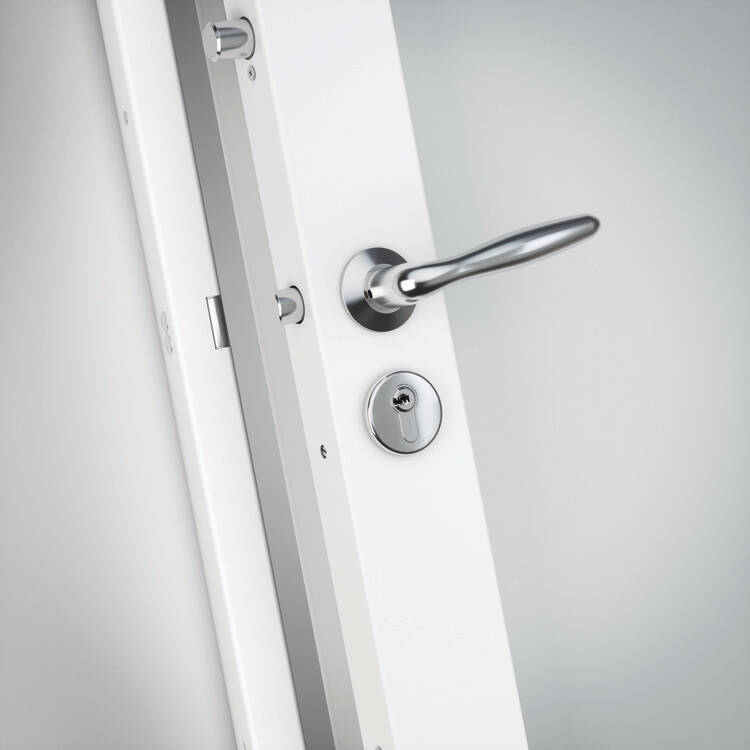
The housing fits into a recess cut into the door's thickness. On the door edge, you can see the faceplate and bolts. The door faces carry the handle and the keyway or cylinder.
This discreet installation needs a lock that fits the existing recess. For a replacement, check the backset, centres, faceplate and locking points. A similar-looking mechanism can have different dimensions.
The rim lock
The housing is fixed to the interior face of the door. It remains visible, along with the corresponding strike plate. In multipoint versions, hinges can transmit movement to other anchor points.
This design can suit a door that is intended to be retained without requiring a housing reservation within its thickness. The quality of the support and fixings remains essential. Handle, pull, and cylinder configurations vary by model.
The full-length covered multipoint lock
The full-length covered multipoint lock is a surface-mounted lock featuring a casing that covers the mechanism and, depending on the model, the transmission components. This casing provides a more integrated finish on the interior side.
It is important to distinguish the casing from the level of protection. Security depends on the complete product and its installation. To repair a full-length covered multipoint lock, the housing, cylinder, and compatible parts are identified; the presence of a casing does not necessitate replacing the entire unit.
Useful information to identify your lock
A general interior photo, a facade photo, and legible markings allow initial assessment. Also indicate the locations of the closure points and the issue encountered.
The number of points is separate information: three points does not necessarily mean three bolts side by side. For a project, MULTISECU checks the door and anchoring points before recommending a repair, a comparable replacement, or an alternative design.
KEY VISUALS

MULTISECU ADVICE
Have a project or a lock
you would like us to check?
Present your requirement and installation. In Annecy and the surrounding areas, we help you distinguish between adjustment, repair, and replacement.