
THE SKILL ALSO MEANS
Short glossary
of locksmithing.
The right words to understand your door. Clear explanations to identify a room, compare mechanisms, and communicate with your locksmith.
10 GUIDES
Components & reference points
Identify what you see on your door.
GLOSSARY · Components & identification
The lock faceplate
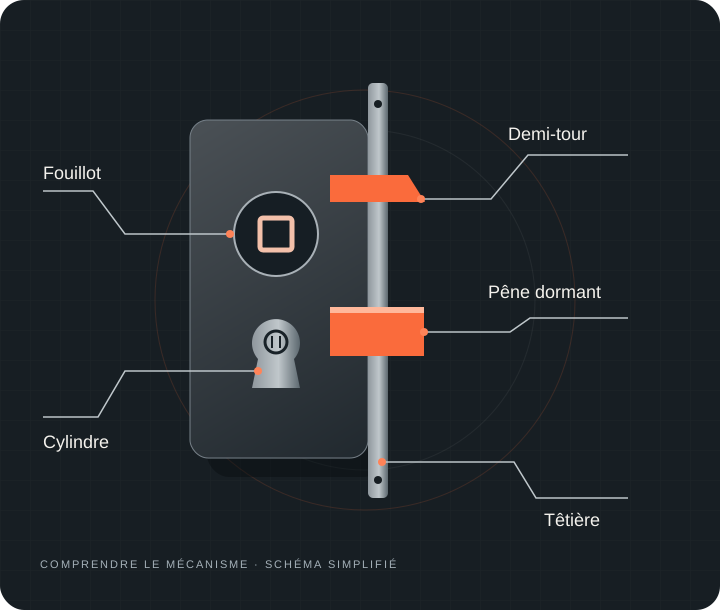
The faceplate is the visible plate on the edge of a door fitted with a mortice lock. It houses the bolt passages and contributes to securing the mechanism within the door frame.
GLOSSARY · Components & identification
The latch-only lock
In French locksmith terminology, “bec-de-cane” refers to the spring latch that holds a door closed and, by extension, an internal door latch using this mechanism. The handle retracts the latch to open the door.
GLOSSARY · Components & identification
The lock cylinder, or barrel
The cylinder is the part of the lock that receives the key and enables its operation on the mechanism. It is often replaceable independently of the safe, allowing, for example, key changes without replacing the entire lock.
GLOSSARY · Components & identification
Half-cylinder of the lock
A half-cylinder has a single key entry. It allows commanding a mechanism from one side, particularly on certain garages, technical rooms, barriers, or keyed contactors.
GLOSSARY · Components & identification
The cam
On a cylinder, the cam is the driving component that rotates to engage the lock mechanism. The same term also refers to the active part of certain keyed cylinders.
GLOSSARY · Components & identification
The lock bolt
The bolt is the moving part that engages with a strike plate to hold or lock a door. Its shape and operation depend on the function of the lock.
GLOSSARY · Components & identification
Latch bolt
The latch bolt is the moving component, often beveled and spring-assisted, which maintains the door closed when it reaches the strike plate. The handle typically allows for retraction of the bolt.
GLOSSARY · Components & identification
The wafers in the cylinder
The wafers are small movable components found in many cylinders. They contribute to key recognition and allow rotor rotation when correctly positioned.
GLOSSARY · Components & identification
The lock backset
The shaft is a horizontal dimension essential for identifying a lock. On an in-situ lock, it is measured from the face of the faceplate to the centre of the operating mechanism as indicated by the manufacturer.
GLOSSARY · Components & identification
Lock and cylinder: the difference
The lock is the mechanism that controls the door closure. The cylinder, also known as the lock cylinder, is the component that receives the key and enables the command of this mechanism.
08 GUIDES
Types of locks
Understand the installation, ordering, and operation.
GLOSSARY · Types of lock
A handle follower lock
In a handle-operated lock, the square spindle fits into a rotating follower in the lock case. Pressing the lever normally turns the follower and retracts the latch bolt.
GLOSSARY · Types of lock
Mortice lock
A mortice lock is integrated into a recess cut into the door thickness. It is also known as a mortised lock or in-situ lock.
GLOSSARY · Types of lock
The mortice lock
The mortise lock takes its name from the mortise: the recess that receives its cabinet in the door. This inset installation requires precise dimensions to ensure proper operation of the window frame.
GLOSSARY · Types of lock
The lift-to-lock mechanism
A hinge-lift lock uses the upward movement of the handle to engage part of its locking points. The key is then used, on standard models, to secure the mechanism.
GLOSSARY · Types of lock
The full-length covered multipoint lock
A full-length covered multipoint lock is a rim lock whose mechanism and trim are enclosed by a cover. It provides a continuous finish on the interior face of the door.
GLOSSARY · Types of lock
The rim lock
A rim lock features a lock case mounted to the surface of the door, typically on the interior side. Its mechanism remains visible, unlike that of a mortice lock.
GLOSSARY · Types of lock
Mortice lock
A mortice lock has its case recessed into the door. This type of lock is available for both internal doors and entrance doors.
GLOSSARY · Types of lock
Tubular lock
On a door, a tubular lock is a compact unit whose operation is often integrated into a handle or a button. The mechanism and bolt fit into specially adapted cutouts for this system.
06 FICHES
Locking & protection
Distinguish the uses and select a consistent solution.
GLOSSARY · Locking & protection
The door espagnolette mechanism
An espagnolette mechanism operates several locking points using rods connected to a central mechanism. Its design depends on the door or French window and how it is used, including whether it secures the normally fixed leaf of a double door.
GLOSSARY · Locking & protection
Mechanical combination lock
A mechanical combination lock allows opening via a code without electrical power. It can be fitted to a door, shared access, or a safe, with highly different mechanisms depending on the application.
GLOSSARY · Locking & protection
Picketing: understanding and preventing
Picking refers to manipulating the internal components of a lock to open it without the original key. Understanding this type of attack helps select appropriate protection for the door.
GLOSSARY · Locking & protection
The cylinder-operated rim deadlock
A cylinder lock combines a small lockbox, a bolt, and a cylinder operated by a key. It can complement a lock or secure a secondary access, depending on the model and the support's resistance.
GLOSSARY · Locking & protection
The security deadlock
A security lock adds a barrier to a door or equips an appropriate access point. Its effectiveness depends on its actual strength, installation quality, and the sturdiness of the frame receiving it.
GLOSSARY · Locking & protection
Key-operated lock, slide bolt or hook?
These three fittings maintain a closed position, but they serve different purposes. A lock can provide a keyed closure; a simple catch or hook is mainly for holding or privacy.
04 FICHES
Installation, mechanisms & history.
Identify an architecture and discover the origins of the trade.
GLOSSARY · TYPES OF INSTALLATION
Mortice, rim or full-length covered lock: recognise the fitting type
A lock can be described by how it operates, how many locking points it has and how it is fitted. Mortice, rim and covered multipoint locks differ primarily in how the mechanism is installed and enclosed on the door.
GLOSSARY · MECHANISMS & KEYS
Double-Bitted Locks: Recognising the Key and Mechanism
A double cam key features two parts cut around its shaft. It is associated with certain groove mechanisms, particularly on older locks or equipment from different generations.
GLOSSARY · HISTORY
The History of Locks: From Mechanical to Electronic Access
To protect a passage, reserve access, or preserve belongings: these needs have accompanied the evolution of the lock. Its history can be read through the materials, mechanisms, and the way a key is recognised.
GLOSSARY · CULTURE & SKILL
Louis XVI and Locksmithing: A Passion for Mechanics
Louis XVI was interested in sciences and techniques. Locksmithing formed part of his mechanical pursuits: a documented aspect of his life, which can be explored without reducing his legacy to this single interest.
MULTISECU ADVICE
Uncertain about your lock?
A photo of the mechanism, along with some details about your door: we help you identify the right solution.